Part I
[This is the first of a series of short histories of University of Toronto sites and artifacts.]
On the St George Campus at the University of Toronto, thousands of people every day walk by a small collection of monuments just in front of the Sanford Fleming Building and Convocation Hall. These mark the location of the Toronto Magnetic Observatory, a scientific facility established by the British government in 1839 as part of a global project to track changes in the earth’s magnetic field.
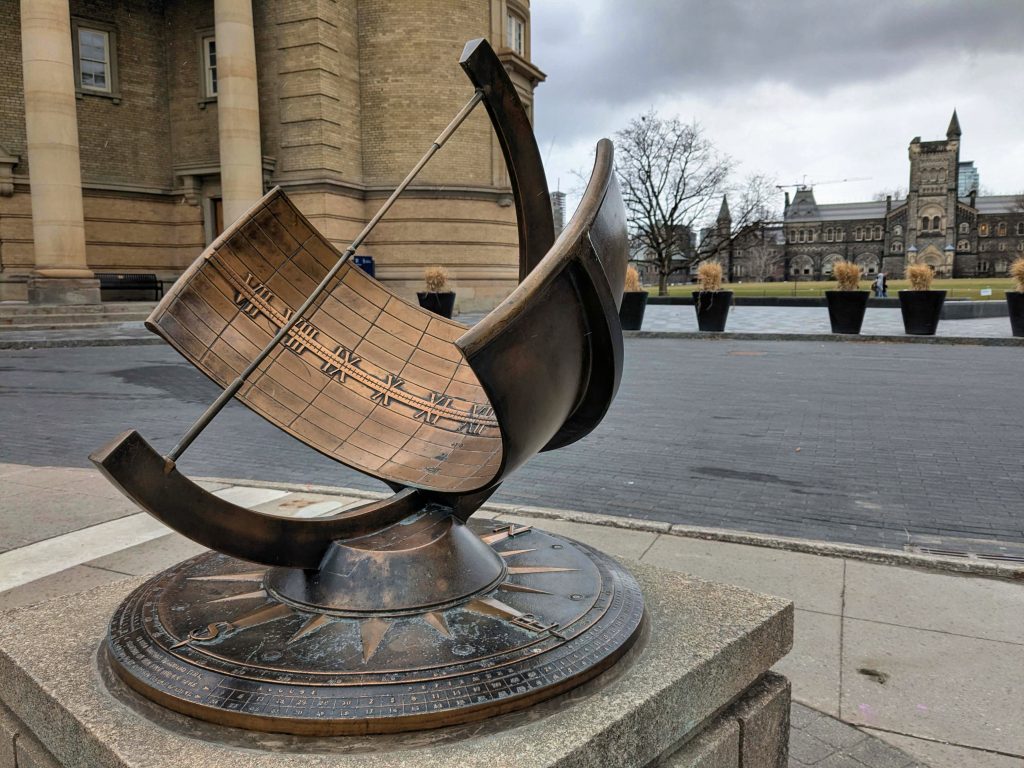
While it wasn’t a university building until the 20th century, its location on the campus was both deliberate and productive. From its modest beginnings alongside the university’s predecessor King’s College, and for almost seventy years afterwards, it was a visible symbol of science in Toronto, representing academic ambitions and the ideals of colonial civilisation. Today, surrounded by indifferent construction hoarding and little maintained, it’s easy to overlook that these monuments are remnants of one of the earliest Canadian scientific projects.
The British magnetic survey emerged in the 1830s in part at the urging of Prussian polymath Alexander von Humboldt, who wrote to the British government suggesting they establish an observatory network which would capitalise on the vast global holdings of the then-British Empire.1
Von Humboldt was urging on the basis of scientific curiosity—the earth’s magnetism was not well understood—but the project had practical purposes as well for British naval and therefore imperial and colonial power. Marine navigation relied heavily on the magnetic compass, and even small variations in magnetic north could endanger shipping and affect trade and military action at sea and on land—both crucial to the wealth and power of the Empire.
With the British scientific establishment and government on board, a network of observatories in far-flung locales was proposed, to be overseen by Artillery officer Edward Sabine, the Irish scientist in charge of the project. As well as measurement at Sabine’s home base of Trinity College, Dublin, and the Empire’s central facility at Greenwich Observatory in London, there would be magnetic observatories at the island of Saint Helena in the South Atlantic, at the existing Royal Observatory, Cape of Good Hope (South Africa), Van Dieman’s Land (Tasmania), and Canada—the latter two representing points of high magnetic intensity. Other countries would be encouraged to establish observatories as well.
Artillery Lieutenant Charles Riddell was assigned the job of establishing the Canadian observatory, and his letters to Sabine tell the story of the project’s early months. Initially, the observatory was planned for Canada’s then-largest city, Montreal, but measurements made in September and October of 1839 determined that Montreal’s magnetic bedrock—in fact, along the whole of the St Lawrence—would cause too much interference. Instead, the Observatory would be located in the capital of Upper Canada: Toronto, a swampy town on Lake Ontario resting on an ancient loamy lakebed.
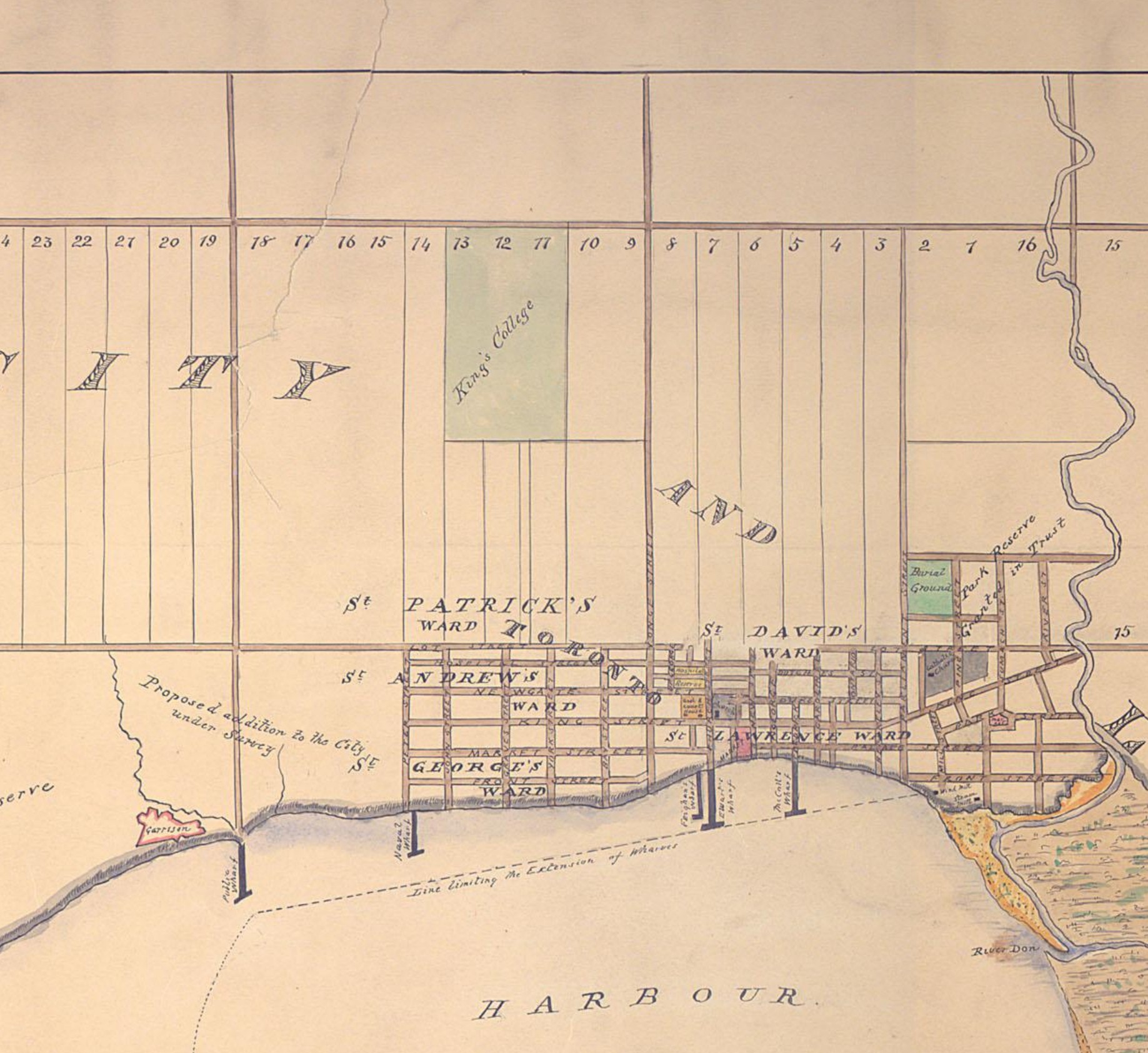
With the transfer of the project to Toronto, the winter frosts were setting in before supplies and funds could be organised. Riddell was obliged to delay the construction of an observatory, but he began measurement in February of 1840. These were made where Riddell was staying, at city’s military base, Fort York. In the spring, construction began on a permanent building in the grounds of King’s College, the predecessor of the University of Toronto. Riddell was seeking a spot far enough from the Fort to avoid the interference of gunfire, the iron of guns, and the eight-hundred rowdy soldiers of the local garrison.2
The agreement between the government and university for the land included that the buildings must only be used for science, and following the conclusion of the observatory project, the land and building would revert to university ownership, and be available for university science.
“As the object is purely scientific and the neighbourhood of the observatory might at a future period be a benefit to the university, I take the liberty of requesting that… [the college] would be pleased to grant to Her Majesty’s Government a sufficient space of ground (viz. two acres) for the erection of a magnetic and meteorological observatory…” 3
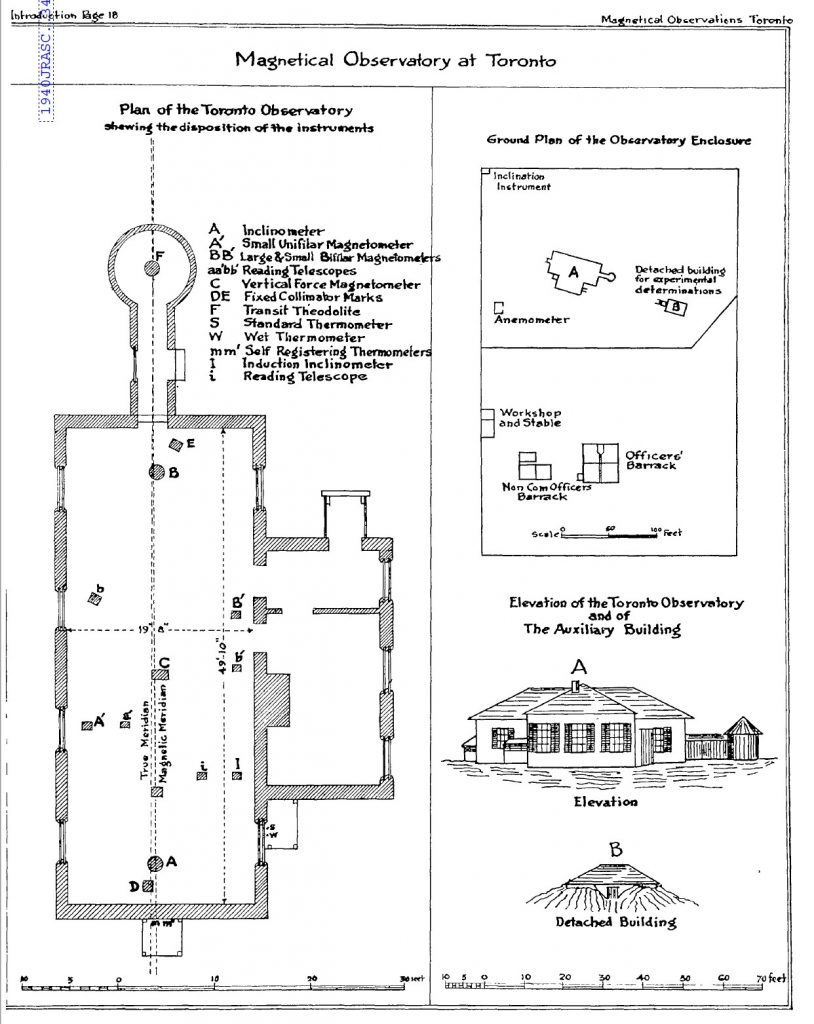
With little stone available in the Toronto area, and bricks being too magnetic, the observatory was a log-built single-floor wood-and-plaster cabin with copper nails and thick insulative walls–a second shipment of copper nails had to be procured from New York when the quantity dispatched from Britain was insufficient.4 A secondary detached building insulated with earth was also constructed “for experimental determinations.”5
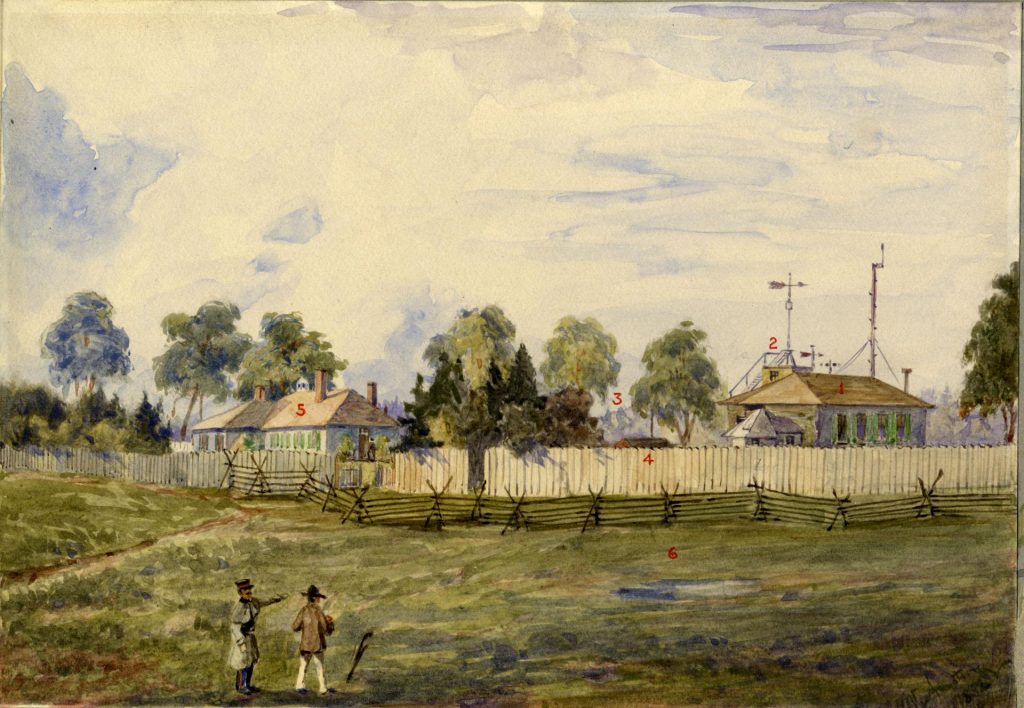
The ten tons of instruments imported from Britain by Riddell were installed in the new building in September 1840. This included a declinometer, various magnetometers, meteorological instruments, and a transit instrument which marked the official Toronto meridian for time determinations. These sensitive instruments each sat on a separate stone pillar installed deep in the earth separate from the floor of the building, so readings would not be affected by vibrations.
Riddell only saw the opening of the observatory before poor digestive health meant he was forced to leave Toronto. He was replaced in 1842 by Lieutenant John Lefroy, previously of the St Helena Observatory. However, Lefroy was often away from the observatory making magnetic observations overland, and the observatory was operated by the then only-20-year-old Lieutenant Charles Younghusband and a series of non-commissioned officers and enlisted men. In the small outpost garrison of Toronto, the available assistants were not especially reliable, and often were reported as drunk on duty.6
Readings were taken on each instrument multiple times in a day, depending on instruments, with some readings taken four times daily, hourly or even every five minutes. At times of particular interest, many readings could become even more frequent: On September 25th, 1841, the Toronto observatory noticed especially intense magnetic readings, and began to take measurements every 1.5 minutes, a schedule they kept up until readings returned to normal twenty hours later. Later, Edward Sabine compared readings between observatories, finding readings all over the world were simultaneously elevated, and during this period, aurora were observed, providing insight into the origin of disturbed magnetic readings.
Major shifts in terrestrial magnetism occurring about the same time around the world seemed to come from somewhere outside of planet Earth. This was in line with emerging theories of the era that connected terrestrial magnetic readings with solar and lunar changes.7
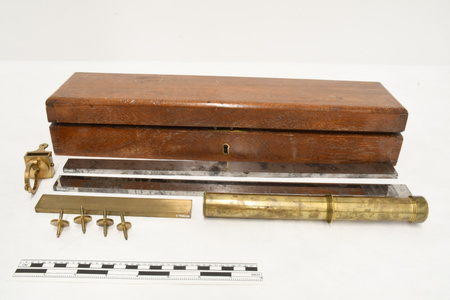
The observatory was also making other types of observations. For example, in 1849, Lefroy observed that during one of the cholera outbreaks that plagued Toronto in this era, he had trouble magnetizing an iron bar, a fact he suggested a possible link between electro-magnetism and illness.
“It would appear as if at the present moment, while Cholera is prevalent in Toronto, the ordinary electro-magnetic influences are inoperative… We feel now the want of any apparatus for atmospheric electricity.”8
Far exceeding its original three-year plan, by the beginning of the 1850s, the British-led project was winding down. Determined to retain the observatory and its scientific work in Toronto, Lefroy lobbied the Canadian government to take on the facility. In 1853–with a small interruption–the magnetic observatory’s operations were transferred to the Province of Canada, and the now aging earth-and-wood cabin rebuilt as a small stone building.9 A photograph of around 1857, taken from the still relatively new tower of the main, and sole, University of Toronto building (now University College) shows the 1854 observatory still surrounded by open fields.
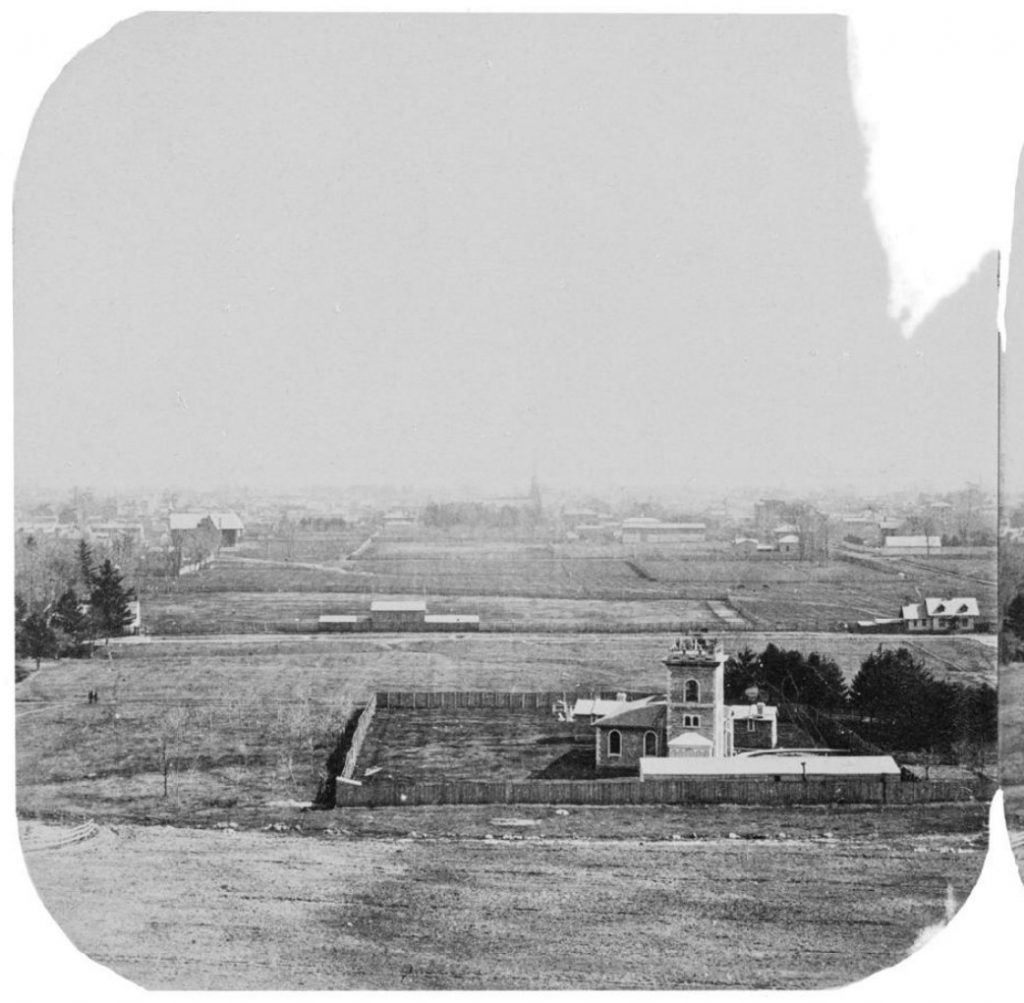
From its inception, the Toronto Magnetic Observatory was a landmark and source of pride for the city and for the university. To people like John Lefroy, it represented the aspirational ideals of the Empire and the supposedly civilising influence of science to Toronto and in Canada more broadly—he suggested it be used to train useful colonists in surveying, engineering, and the use of instruments.
Daniel Wilson, writer and one of the most influential early presidents of the university, wrote about the stone building in 1860:
“There is something grand and ennobling in reflecting on the patient labors of the Magnetic, as of the Astronomical, observer. In that little building which rears its modest tower in the University Park, apart from all our busy thoroughfares, on a spot so recently hewn out of the forest wilderness…”10
This perception of the observatory as a small island of patient scientific civilisation shining out into a recent perceived “wilderness” is evocative of the mindset surrounding the role of science and education of the era within British colonies.
Nothing visible remains of the original structure of 1840 except the memorial landmarks in front of the Sandford Fleming building and Convocation Hall. Visiting the location, you can find the Toronto meridian marked in a brass strip, just as it ran through the observatory. This meridian is a trace of some of the earliest permanent scientific research projects in Upper Canada; the first observatory in modern Ontario, and, in its time, a significant symbol of the intellectual potential of the city of Toronto.
If you know the St George Campus at the University of Toronto, you may recognise the 1854 stone building. In 1907, and in recognition of its historic importance, the building was disassembled and moved to its present location in front of Hart House, finally becoming part of the University of Toronto proper.
- Sabine, E. Observations Made at the Magnetic and Meteorological Observatory at Toronto, Canada, Vol. I (1845), 10-11. ↩︎
- Letter from C. Riddell to The Deputy Adjutant General, Royal Artillery, November 14, 1839. Thiessen, A.D. “The Founding of the Toronto Magnetic Observatory and the Canadian Meteorological Service” Journal of the Royal Astronomical Society of Canada Vol. 34, 308-348 (1940), 320. ↩︎
- Letter from C. Riddell to The Bursar of the Upper Canada College, Toronto, December 19, 1839. Thiessen (1940): 341 ↩︎
- Letter from C. Riddell to The Deputy Adjutant General, Royal Artillery, July 4, 1840. Thiessen (1940), 334. ↩︎
- Sabine, E. Observations Made at the Magnetic and Meteorological Observatory at Toronto, Canada, Vol. I (1845), 18; copy appearing in Thiessen (1940), Plate XIV. ↩︎
- Thiessen, A.D. “Her Majesty’s Magnetical and Meteorological Observatory, Toronto”Journal of the Royal Astronomical Society of Canada, Vol. 35, 205 (June 1941). ↩︎
- Sabine, Edward. Observations Made at the Magnetic and Meteorological Observatory at Toronto in Canada, Vol III 1846, 1847, 1848, (London: Longman, Brown, Green and Longmans, 1857) pg x–xi, lxxvi. ↩︎
- Letter from J.H. LeFroy to E. Sabine, August 15, 1849. Thiessen, E. “Her Majesty’s Magnetical and Meteorological Observatory, Toronto, Journal of the Royal Astronomical Society of Canada Vol. 39, 355-369 (1945), 367. ↩︎
- Stupart, R.F. “The Toronto Magnetic Observatory” Terrestrial Magnetism vol. 3 Iss. 4 (December 1898), 146. ↩︎
- Wilson, Daniel. 1860. “The President’s Address” The Canadian Journal – New Series, XXVI, 109-127 (March 1860), 112. ↩︎
Recent Comments