These days, at 153 years old, the University of Toronto’s Faculty of Applied Science & Engineering offers a competitive teaching program educating over six thousand undergraduate students spread over ten specialisations and a large and prestigious graduate school and research program. Anyone on the University of Toronto’s St George campus during the first week of September will certainly be aware of the presence of the thousands of incoming undergraduate engineering students, whose distinctive outfits, “enthusiastic” band and sometimes purple colouring are unavoidable. During Frosh week, it’s hard to imagine Engineering being anything but a permanent and prominent feature of the university, but there was a time when any affiliation with the university was uncertain, even rejected.
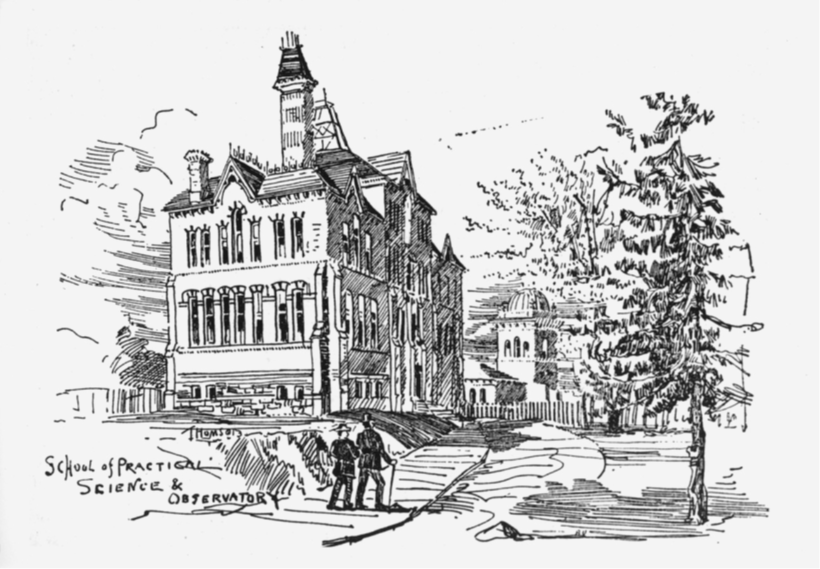
Engineering at U of T actually began somewhat more than 153 years ago. With interest in formal engineering training growing in anglophone contexts through the middle part of the 19th century, and an increased need for engineers to build the structures of growing colonial Canada, the university founded a chair of civil engineering in 1851. However, the position was never filled, in part because universities resisted practical work-training programs in their rarefied, scholastic environments. Graduating only seven students, this initial Toronto effort, like those at other Canadian universities during the same era, sputtered and petered out.
Perhaps because of this scholarly objection to practical work, when the Ontario government embarked on the project of establishing an engineering training program in Ontario in the early 1870s, it sent a delegation to inspect US engineering schools operating largely outside universities, such as Harvard’s Lawrence School of Science and MIT. In 1871, the Ontario delegation reported it had received some very clear, and somewhat controversial, advice: on no account was a school of engineering to be closely affiliated with a university—to make this link was fatal to technical schools’ success.1
Even as disagreement about the affiliation (or not) of an engineering school rumbled on in parliament and the newspapers, a new Ontario government began offering classes in an independent “School of Technology” in 1872. The discussion about the nature of the school was still not settled when, in 1873, the government passed a bill for a “School of Practical Science” (SPS) with a broad, technical mandate: “the training of Engineers, Civil, Mechanical and Mining; of Industrial Chemists; and holding of evening classes for the teaching of Artisans.”2 Although not fully affiliated with the university, the intention was now that—eventually—the connection would be made.
“School of Practical Science?“
The source for this distinctive name is unclear. U of T Professor James Loudon claimed it had come from a school of the same name in Dublin, and in fact objected to the title as he believe it implied no “practical” work was being done in the Faculty of Arts. However, although the term “school of practical science” was regularly used to casually describe such schools in the 19th century, and Dublin did have a “School of Science applied to Mining and the Arts,” no previous college or school seems to have used this name in an official capacity for any significant amount of time.
Toronto’s School of Practical Science, therefore, was unique in adopting this moniker, until a similar school was opened in Kingston. Later, Loudon took the credit for the name.
Between 1873 and 1878, the SPS was a small operation with five instructors working out of rented rooms at Adelaide and Church—nowhere near the university. Among the teachers was James Loudon, a young University of Toronto physics and mathematics instructor who had been trying to introduce practical laboratory teaching to U of T’s wholly lecture-based physics program. Loudon taught mechanics and “light” (i.e. optics) at the technical school from 1872, and was an influential voice in shaping the future SPS.3
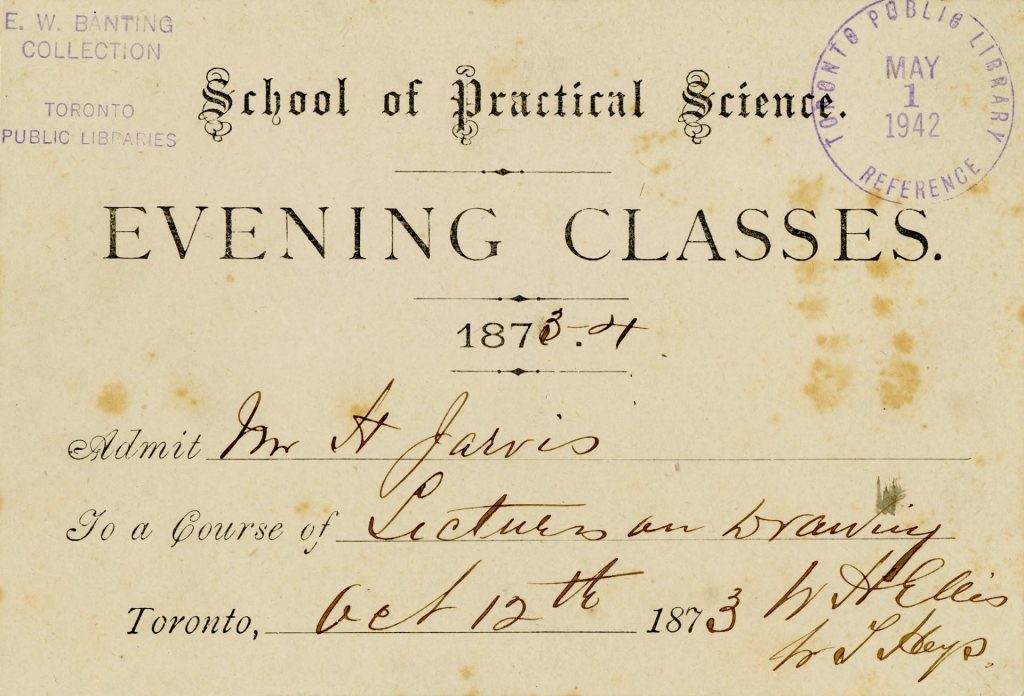
In an 1875 Report to the government, Loudon laid out his vision. Although a separate, but affiliated school with multiple engineering professors would be ideal, he said, it would be extremely expensive and he did not think it was yet necessary in Canada. Hiring an engineering professor at the University of Toronto and supplying a small laboratory would be sufficient for the demand. More important, he argued—and not trying very hard to hide his bias—was a properly equipped physical laboratory—this would supply the physics education needed by any university engineers as well as Arts students.4
The School of Practical Science that opened just three years later in 1878 was therefore the result of mixed influences and no small amount of debate. With a brand-new purpose-built building, equipped with chemical and mechanical laboratories5 and offering training in subjects that included “Engineering and Mining,” “Surveying,” and “Machinery,” it was not quite Loudon’s unambitious affair. Yet, neither was it wholly independent. Only one new professor, John Galbraith, was hired to teach civil engineering, with the rest of the teaching staff (but one, coming from the earlier school) shared with the university. The majority of the students taking classes in the first years were Arts students enrolled at University College.6
This building, located between College Street and University College and known fondly by its red brick walls as the Little Red Schoolhouse, was the first home of the Faculty of Engineering at the University of Toronto. Starting small, it grew enormously quickly. By 1900, when it was officially renamed the Faculty of Applied Science and Engineering, it had 228 enrolled students and gained a new building to accommodate its burgeoning population. By then, it had developed an established and inextricable role at the university, as well as a more distinctive identity of its own, training students crucial to Canada’s transformation in an era defined by exciting changes in the mechanical, technical, and electrical fields.
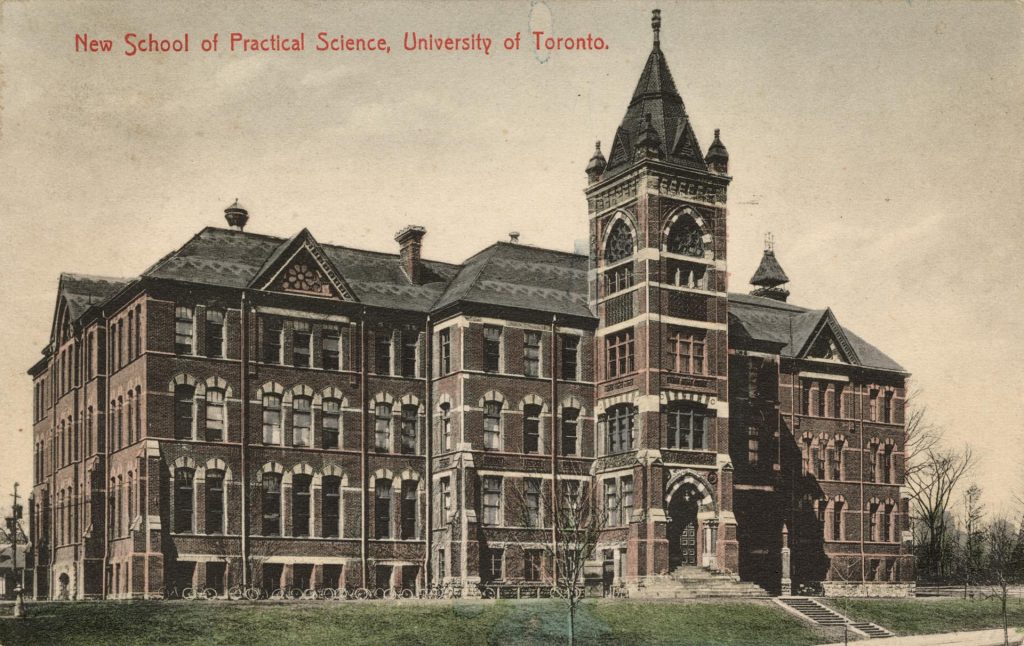
Aside from training generations of Canadian engineers, Engineering at U of T also had a profound effect on practical science at the university. Loudon’s physics laboratories were boosted by the need to train the numerous engineers. Although it was not always entirely amicable, this partnership between science in the Faculty of Arts (and later Arts & Science) and Engineering was beneficial through the early part of both their lives. Although classes were eventually offered separately, programs such as Engineering Physics—founded at University of Toronto in the 1920s—continued this important relationship through the 20th century and to the present day.
The Little Red Schoolhouse stood until 1966, when, long since outdated, it was demolished to make way for the Medical Sciences Building. Pieces of its red façade are visible in the lobby of Engineering’s Galbraith Building, which was named for the first professor and principal of the SPS.
Even earlier pieces of history also survive. The University of Toronto Scientific Instruments Collection holds a lens made by W. Ladd of London which cannot date to later than 1875. It is very likely that this is one of the British-made lenses that James Loudon was able to purchase in around 1875 for his classes in optics at the nascent School of Practical Science. It stands for a period in time when the future of the University of Toronto’s Faculty of Engineering was uncertain, and yet also of the beginnings of a relationship between engineering and science that today is impossible to imagine the university without.
This post was written in part with material from my doctoral thesis, ‘Getting Down to Brass & Wax: The Material Culture of Physics at Canadian Universities, 1890-1939’
- Hodgins, J.G., Machattie, A. “Report of an Inquiry in Regard to Schools of Technical Science in the United States, 1871,” in George S. Hodgins (ed.) Documentary History of Education in Upper Canada Volume XXIII 1875–1876. (Toronto: L.K. Cameron, 1908), 10. ↩︎
- Loudon, J. Bound manuscript of memoirs “The Memoirs of James Loudon: President of the University of Toronto, 1892–1906” (1913), 35. University of Toronto Archives B1972-0031 Box 16 File 11. ↩︎
- Ibid, 22–23. ↩︎
- Loudon, J. “Report on the School of Practical Science”17th December 1875, in George S. Hodgins (ed.) Documentary History of Education in Upper Canada (Ontario) vol. XXVII 1875-1876. (Toronto: L.K. Cameron, 1908), 87–88. ↩︎
- Young, C.R. Early engineering education at Toronto, 1851-1919 (Toronto: Toronto University Press, 1958), 59–60. ↩︎
- Ibid, 65–67. ↩︎
Recent Comments