Historian, Author, Photographs

Tag: history of science

Practical Science for Ontario: The origins of the University of Toronto’s Faculty of Engineering

These days, at 153 years old, the University of Toronto’s Faculty of Applied Science & Engineering offers a competitive teaching program educating over six thousand undergraduate students spread over ten specialisations and a large and prestigious graduate school and research program. Anyone on the University of Toronto’s St George campus during the first week of September will certainly be aware of the presence of the thousands of incoming undergraduate engineering students, whose distinctive outfits, “enthusiastic” band and sometimes purple colouring are unavoidable. During Frosh week, it’s hard to imagine Engineering being anything but a permanent and prominent feature of the university, but there was a time when any affiliation with the university was uncertain, even rejected.
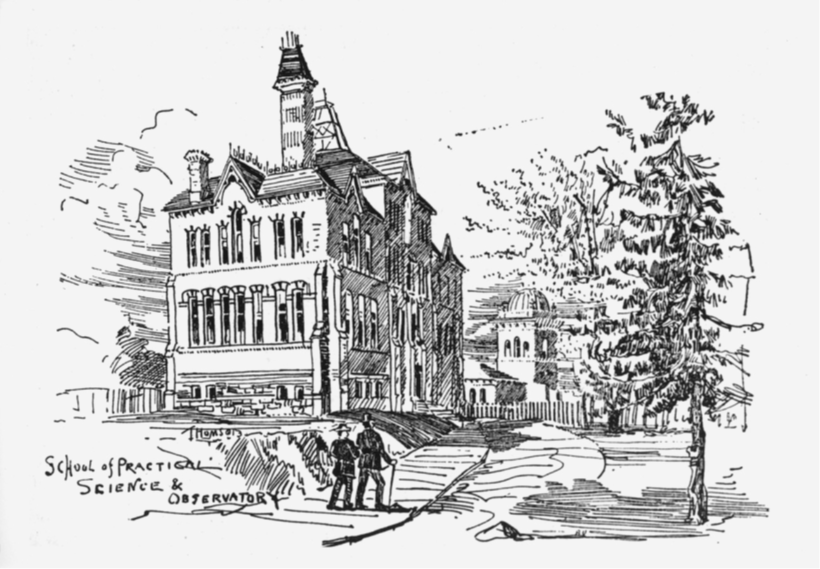
Engineering at U of T emerged in the late 1870s with the School of Practical Science. The presence of the Magnetic & Meteorological Observatory in the background shows both the building’s orientation and also perhaps emphasised its scientific connections. (Toronto “Globe“, June 15, 1889. University of Toronto Archives 2001-15-35MS)

Engineering at U of T actually began somewhat more than 153 years ago. With interest in formal engineering training growing in anglophone contexts through the middle part of the 19th century, and an increased need for engineers to build the structures of growing colonial Canada, the university founded a chair of civil engineering in 1851. However, the position was never filled, in part because universities resisted practical work-training programs in their rarefied, scholastic environments. Graduating only seven students, this initial Toronto effort, like those at other Canadian universities during the same era, sputtered and petered out.

Perhaps because of this scholarly objection to practical work, when the Ontario government embarked on the project of establishing an engineering training program in Ontario in the early 1870s, it sent a delegation to inspect US engineering schools operating largely outside universities, such as Harvard’s Lawrence School of Science and MIT. In 1871, the Ontario delegation reported it had received some very clear, and somewhat controversial, advice: on no account was a school of engineering to be closely affiliated with a university—to make this link was fatal to technical schools’ success.1

Even as disagreement about the affiliation (or not) of an engineering school rumbled on in parliament and the newspapers, a new Ontario government began offering classes in an independent “School of Technology” in 1872. The discussion about the nature of the school was still not settled when, in 1873, the government passed a bill for a “School of Practical Science” (SPS) with a broad, technical mandate: “the training of Engineers, Civil, Mechanical and Mining; of Industrial Chemists; and holding of evening classes for the teaching of Artisans.”2 Although not fully affiliated with the university, the intention was now that—eventually—the connection would be made.

“School of Practical Science?

The source for this distinctive name is unclear. U of T Professor James Loudon claimed it had come from a school of the same name in Dublin, and in fact objected to the title as he believe it implied no “practical” work was being done in the Faculty of Arts. However, although the term “school of practical science” was regularly used to casually describe such schools in the 19th century, and Dublin did have a “School of Science applied to Mining and the Arts,” no previous college or school seems to have used this name in an official capacity for any significant amount of time.

Toronto’s School of Practical Science, therefore, was unique in adopting this moniker, until a similar school was opened in Kingston. Later, Loudon took the credit for the name.

Between 1873 and 1878, the SPS was a small operation with five instructors working out of rented rooms at Adelaide and Church—nowhere near the university. Among the teachers was James Loudon, a young University of Toronto physics and mathematics instructor who had been trying to introduce practical laboratory teaching to U of T’s wholly lecture-based physics program. Loudon taught mechanics and “light” (i.e. optics) at the technical school from 1872,  and was an influential voice in shaping the future SPS.3
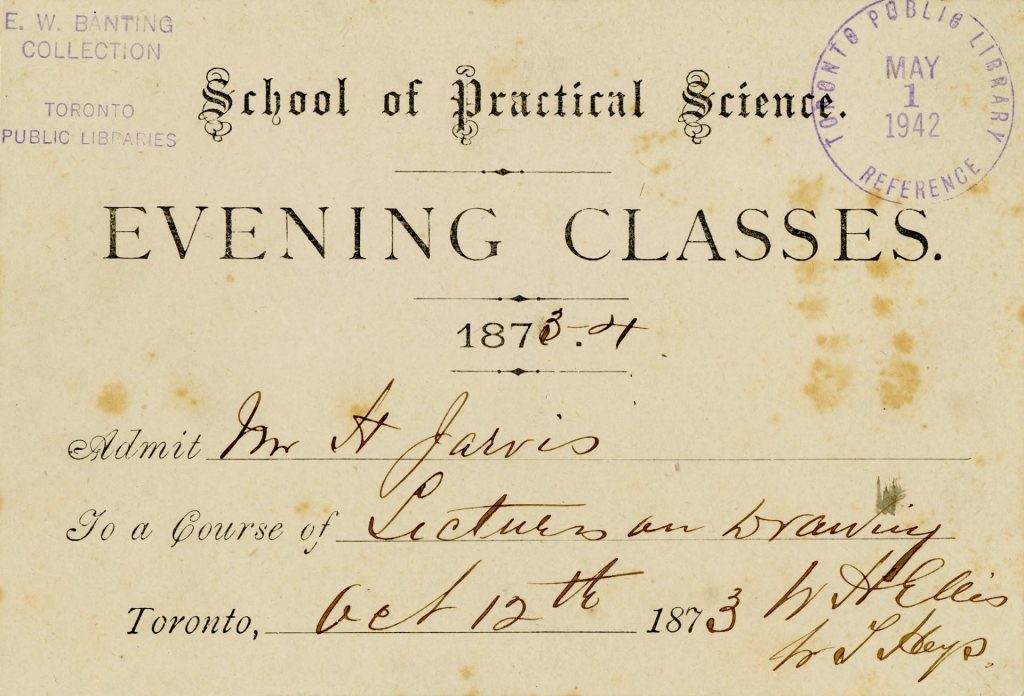
An 1873-1874 SPS evening class admission note for a student, Mr. H. Jarvis, studying architectural drawing at evening classes. (Toronto Public Library Digital Archive. 1873- PRACTICAL-SCIENCE-VS 97105)

In an 1875 Report to the government, Loudon laid out his vision. Although a separate, but affiliated school with multiple engineering professors would be ideal, he said, it would be extremely expensive and he did not think it was yet necessary in Canada. Hiring an engineering professor at the University of Toronto and supplying a small laboratory would be sufficient for the demand. More important, he argued—and not trying very hard to hide his bias—was a properly equipped physical laboratory—this would supply the physics education needed by any university engineers as well as Arts students.4 

The School of Practical Science that opened just three years later in 1878 was therefore the result of mixed influences and no small amount of debate. With a brand-new purpose-built building, equipped with chemical and mechanical laboratories5 and offering training in subjects that included “Engineering and Mining,” “Surveying,” and “Machinery,” it was not quite Loudon’s unambitious affair. Yet, neither was it wholly independent. Only one new professor, John Galbraith, was hired to teach civil engineering, with the rest of the teaching staff (but one, coming from the earlier school) shared with the university. The majority of the students taking classes in the first years were Arts students enrolled at University College.6

This building, located between College Street and University College and known fondly by its red brick walls as the Little Red Schoolhouse, was the first home of the Faculty of Engineering at the University of Toronto. Starting small, it grew enormously quickly. By 1900, when it was officially renamed the Faculty of Applied Science and Engineering, it had 228 enrolled students and gained a new building to accommodate its burgeoning population. By then, it had developed an established and inextricable role at the university, as well as a more distinctive identity of its own, training students crucial to Canada’s transformation in an era defined by exciting changes in the mechanical, technical, and electrical fields.
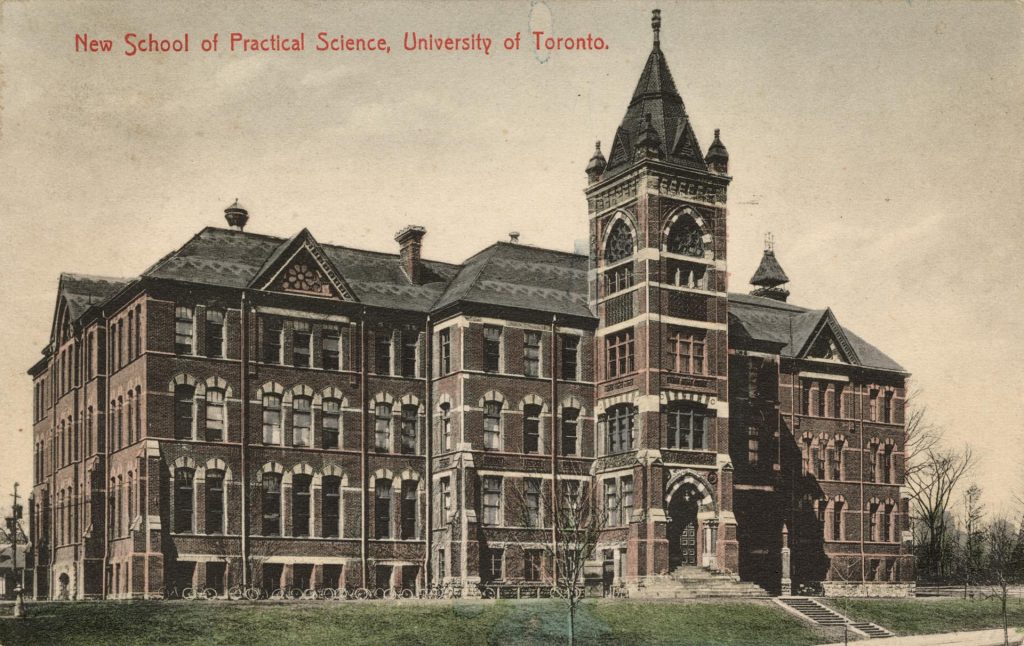
The “Little Red Schoolhouse” pictured in a colourised postcard, likely c. 1890s. Bicycles are visible lined up outside the building. (Toronto Public Library Digital Archive PC_5778).

Aside from training generations of Canadian engineers, Engineering at U of T also had a profound effect on practical science at the university. Loudon’s physics laboratories were boosted by the need to train the numerous engineers. Although it was not always entirely amicable, this partnership between science in the Faculty of Arts (and later Arts & Science) and Engineering was beneficial through the early part of both their lives. Although classes were eventually offered separately, programs such as Engineering Physics—founded at University of Toronto in the 1920s—continued this important relationship through the 20th century and to the present day.

The Little Red Schoolhouse stood until 1966, when, long since outdated, it was demolished to make way for the Medical Sciences Building. Pieces of its red façade are visible in the lobby of Engineering’s Galbraith Building, which was named for the first professor and principal of the SPS.

Even earlier pieces of history also survive. The University of Toronto Scientific Instruments Collection holds a lens made by W. Ladd of London which cannot date to later than 1875. It is very likely that this is one of the British-made lenses that James Loudon was able to purchase in around 1875 for his classes in optics at the nascent School of Practical Science. It stands for a period in time when the future of the University of Toronto’s Faculty of Engineering was uncertain, and yet also of the beginnings of a relationship between engineering and science that today is impossible to imagine the university without.

This post was written in part with material from my doctoral thesis, ‘Getting Down to Brass & Wax: The Material Culture of Physics at Canadian Universities, 1890-1939’

  1. Hodgins, J.G., Machattie, A. “Report of an Inquiry in Regard to Schools of Technical Science in the United States, 1871,” in George S. Hodgins (ed.) Documentary History of Education in Upper Canada Volume XXIII 1875–1876. (Toronto: L.K. Cameron, 1908), 10. ↩︎
  2. Loudon, J. Bound manuscript of memoirs “The Memoirs of James Loudon: President of the University of Toronto, 1892–1906” (1913), 35. University of Toronto Archives B1972-0031 Box 16 File 11. ↩︎
  3. Ibid, 22–23. ↩︎
  4. Loudon, J. “Report on the School of Practical Science”17th December 1875, in George S. Hodgins (ed.) Documentary History of Education in Upper Canada (Ontario) vol. XXVII 1875-1876. (Toronto: L.K. Cameron, 1908), 87–88. ↩︎
  5. Young, C.R. Early engineering education at Toronto, 1851-1919 (Toronto: Toronto University Press, 1958), 59–60. ↩︎
  6. Ibid, 65–67. ↩︎

The Artifacts of the Department of Astronomy & Astrophysics at the David Dunlap Observatory

This year, the David Dunlap Observatory (DDO), a historic observatory in and run by the city of Richmond Hill, celebrates its 90th Anniversary! On the weekend of May 31st and June 1st, 90 years to the day of its opening, the observatory celebrated with a special event featuring a cake displays from the two groups that run programming at the observatory, the Royal Astronomical Society of Canada – Toronto Centre and the David Dunlap Observatory Defenders.


Part of the 90th Anniversary weekend display in the ornate David Dunlap Observatory library, showing items displayed on a table with walls of books behind. Photo by Victoria Fisher.

To celebrate the anniversary, I created a exhibit of objects in the observatory’s stunning library. The items on display were all either used at the observatory or connected to people who worked there, and drawn from the David A. Dunlap Department of Astronomy and Astrophysics’ historic collections, which I curate.

This was an amazing opportunity. Many of the artifacts were originally used at the DDO or even designed for it–this includes the “Newtonian Breechpiece” that held photographic plates for the observatory’s huge 74-inch telescope. Other items related to work of the observatory’s researchers, such as the light table that belonged to Helen Sawyer Hogg, a prominent researcher in the field of variable stars who worked at the DDO for decades and took hundreds of photographs she would have viewed with this table. While I use objects from the collection for teaching and pop-up exhibits, this is the first time I have been able to bring them out for an extended display where they can be examined by visitors. I was so excited to get this chance.

Over the anniversary weekend, I was on hand with a colleague, chatting with visitors about the artifacts and the observatory’s history, something I always love to do. Although I can’t be there all summer, and some items had to return to storage for one reason or another, most of the objects are remaining on display all summer for the observatory’s highly popular “Tour the DDO” events, free to the public.

At the birthday even on May 31st, I was invited to speak about Clarence Augustus Chant, a professor at the University of Toronto from whose efforts the observatory came about. This story is a fantastic one, as it highlights a fascinating period in Canadian science at the beginning of the 20th century when the country was just beginning to develop a scientific research identity.

Victoria Fisher speaking at the Richmond Hill David Dunlap Observatory 90th Anniversary event. Photo by Phil Morrow.

Initially a physics professor, Chant taught the first astronomy classes at U of T in 1905. Keen to develop the program’s capacity and impressed by the importance of scientific public education and amateur access to science, he had a vision that not only should the university have its own large telescope for teaching and research, but also that the city of Toronto should have access to a major observatory so that the public could come and learn something about the universe. This “observatory for Toronto”, as Chant called it, opened on Chant’s 70th birthday, May 31st, in 1935, and hosted what was then the world’s second biggest telescope as well as three others. It spent many decades at the heart of the university’s astronomical research program as well as delighting a steady stream of interested members of the public.

In 2007, the University of Toronto sold the observatory. Through the efforts of the City of Richmond Hill and groups of local people determined to maintain the observatory and its surroundings as a historic site and park, it became a National Historic Site in 2019, and still welcomes thousands of visitors a year.

Chant’s legacy is one I’m glad to celebrate, because it still resonates so strongly today. Not only did he believe that Canadian astronomers should have access to high quality research facilities at a time when Canada, but–perhaps even more importantly in the emergence of scientific research and industry in Canada–that science and science education should be accessible to the broader public. As we face a bewildering array of crises and problems that connect with science, industry, and technology, this access, for adults as well as kids, is perhaps more important than ever before.

The main dome of the David Dunlap Observatory on May 30th, 2025. Photo by Victoria Fisher.

I was so excited to include some elements of the DDO’s public education history in the exhibit: Chant’s educational lantern slide set designed to assist in teaching adults and children about astronomy, and a faux “Oscar” statuette featuring an astronaut jokingly awarded to professor Donald MacRae by his department colleagues for his “starring role” in the 1960 documentary, Universe, partly filmed at the DDO.

The exhibit was visible from June to October 2025. In November 2025, a few items went on display at Gerstein Library at the University of Toronto’s St. George Campus.

Artifacts and Opportunity: Discovering Canada’s Scientific Collections

One way the history of science and technology in Canada is recorded is in artifacts–the flotsam and jetsam of scientific and technological activity across the country. From scientific instruments to hospital supplies to botanical specimens and objects of design, many of these artifacts survive in collections, formal and informal, large and small, across the country.

Through 2023 and 2024, with my colleague at the University of Toronto, Erich Weidenhammer, I guest edited an issue of Canada’s history of science academic journal, Scientia Canadensis, that collects new scholarship focusing on some of these collections.

The Special Issue, called “Artifacts and Opportunity: Science and Technology Collections in Canada,” was published in December 2024. You can find and read the articles–all open access–here. The issue is still growing! We expect to add more articles in the near future.

Editing this Special Issue was a fantastic experience. I loved discovering collections through the eyes of the people who care for them. The variety of perspectives, interests and knowledge of the historians, curators and others who work with these collections is distinctive and wonderful. History that pays attention to material artifacts is a special kind of history–it is often local, practical, down-to-earth, and represents types of people and work who may not be recorded in other ways.

Excitingly, I know that these collections represent only a fraction of the material that survives and represents the fascinating stories of natural knowledge, science, technology and ingenuity that Canada has to offer. But many of such collections are at risk, including some of those documented by the authors here. Often already underfunded and under-resourced, collections and the people who care for them are often regarded as expendable. Scientific or technology collections, especially, are often very vulnerable; this is especially true in Canada, where scientific and technology history has sometimes been overlooked.

Yet the history of Canada is tied inextricably with science. From the natural knowledge that enabled Indigenous people from time immemorial to the present day to traverse, understand and live in this land; through the role of navigation and surveying in the processes of colonization; through the central role of natural resource discovery, use and exploitation across the country; through our ingenious scientist, doctors and engineers who developed new technologies that changed how we do things and what we can do; to our extensive and growing understanding of our natural environment and its role in our endangered planet–we have been continually shaped and reshaped by what we know about the world and what we do in it.

Preserving and protecting and learning from these collections is therefore preserving and learning from Canadian history. There are so many stories that are going untold–or that we’ve let be told by someone else! I was very pleased, therefore, to play host to this great collection of scholarship that will help, just a little, to raise the profile and highlight the value of Canada’s amazing and little-known scientific collections.

© 2026 Victoria JL Fisher

Theme by Anders NorenUp ↑